Friday, April 6, 2018

FERRARI 812 ( 2018 )

Ferrari 812 Superfast

The Ferrari 812 Superfast is the latest super-GT car from Maranello, the newest in a long line of front-engined V12s, hence the ‘12’ in the title. It replaces the F12, which wasn’t exactly unsuperfast itself, what with its 730bhp and everything.

But now – and here comes the ‘8’ – peak power is up to 800 metric horsepower, or 789bhp, so if it wasn’t fast enough before, the chances are that it will be now. 

How much power, Raffaele de Simone, Ferrari’s chief test driver and lead engineer, is too much? “If you have control, it’s never enough,” he says.

Righto. Control, mind, was one of the things that the recent, limited-run F12tdf did not offer in quantities to match its 770bhp. The spiky, angry, hard-to-drive special edition felt like it made double that power when it arrived in doses so heady that they overwhelmed a chassis featuring a rear-steer system seemingly intended to confound both itself and its driver. 

Ferrari called that system a ‘virtual short wheelbase’ but, in effect, it did precisely the opposite. By steering the rear wheels in the same direction as the fronts it was adding stability – virtual length – to the tdf’s wheelbase, in an attempt, at which it would mostly fail, to tame a chassis that had been made deliberately unstable by fitting extremely wide front tyres.

Their grip and willingness to turn made the F12tdf feel extraordinarily agile for its size, but combined with the extra power, they also made it impossibly lively, but that was okay because it was a limited-run model only for those in both the club and the right mood. 


The Ferrari 812 Superfast – an untameable beast?


This new 812 Superfast, by way of contrast, is a regular production model, potentially driven by anyone, whatever their mood. So, naturally, it gets precisely the same tyre sizes as the tdf, the same rear-steer system, and even more horsepower. Gulp. 

But hold on. Here’s yer man de Simone again, telling me that the 812 Superfast is, in fact, easier to drive on the limit even than the F12.

Which is no bad thing. The tyres are regular Pirelli P Zeros, the rear-steer system has been honed and tweaked, and it now talks, along with the electronically controlled differential, the stability control and the drift control, to Ferrari’s first application of electrically assisted power steering, itself replacing a hydraulic set-up. It’s all damnably clever. 

Meantime, the rest of the news. This V12 engine’s block made its debut in the 6.0-litre Enzo of 2002. Since then it has grown in capacity and changed in internals and ancillaries and heads and so on, but the block casting itself remains precisely the same. It reached its maximum bore a while ago, but here, now, stroked out to 6.5 litres, it is as large in capacity as it can possibly be. 

Is it approaching the end of its era, then? Not a bit of it, says Ferrari. Yes, it now has a fuel injection system that operates at 350bar (up from 200) and a redline at 8900rpm, but there’s still more to come, apparently. Given that it’s a normally aspirated petrol engine with an already hyperefficient intake and exhaust cycle, that can only mean one thing: new materials that will let it spin faster, so in its next incarnation it should rev past 9000rpm, easily. I mentioned it’s a 6.5-litre V12, right? How wonderful. 

Getting acquainted to the 812 Superfast’s mechanicals
Obviously economy and emissions have to improve, too. The new cleaner injection system helps. So does the stop-start system cutting the engine when you’re decelerating past 5mph, although that does feel weird.

Peak power is at 8500rpm while peak torque of 530lb ft is at 7000rpm, so you suspect this V12 will thrive on revs. Still, 80 percent of torque can be had from 3500rpm. And let’s face it, when peak power is 789bhp, even half of that is a fair chunk. 

The V12 is mated to a seven-speed dual-clutch automatic gearbox, and because the ’box is at the back, it gives the 812 the same slight rearward weight bias – about 53 percent – as the F12 had before it. 

The body structure is largely unchanged from the F12, too. It’s different at the front to accommodate EPAS, not HPAS, and at the back to fit the rear-steer. But, some stiffening fabrication differences aside, it’s little altered. 

Still, 60kg did come out of the F12’s construction: through lighter electrics and plumbing, sound proofing and endless pressure on suppliers. But the stronger engine and rear-steer has put the lot back in again. So claimed weight stays at 1630kg (call it just over 1700kg on our scales, given that we tested an F12 at 1715kg). Which is a fair whack. 

It’s aggressive to look at. There are aerodynamic details aplenty to pore over, plus a vast open frontal grille, or “smile”, Ferrari calls it, which is to friendly smiles what eating your kids is to childminding. Inside there are two seats, a driver-centric instrument stack, a supplementary instrument binnacle for the passenger (very cool) and a bit of oddment storage. Behind all that is a hatch with a decent-sized but high-temperature boot. 


Unleashing the 812 Superfast’s ramping stallions


There’s apparently less soundproofing in the 812 than there was in the F12, but on start-up I doubt you’d tell. Ferrari people say they want to let in the good noises but not the bad ones, but the difference between volumes inside and outside the car is vast. From inside, the V12 barks and fizzes, but the overriding impression is one of a perfectly smooth – and razor-sharp – engine. From outside it sounds like the atmosphere is being cleaved in two. 

Engine response is fabulous. Oh, it’s tractable enough and you can leave the steering wheel dial in Wet or Sport and the gearbox in Auto and it’ll bimble about at low revs all day long, but you’ll be wasting everybody’s efforts if you do that.

When I tell you that the throttle map is slightly softer than a tdf’s, I might as well be telling you that tungsten is slightly easier to melt than carbon. It’s still more wickedly responsive than, by my reckoning, any other current production car’s engine. Lamborghini Aventador aside? Perhaps. But perhaps not. 

What that means is that the 812 is bafflingly, shockingly urgent; aggressive and hard but cultured and rounded. There is never a bum note or semiquaver played out of time. It is at once the most powerful series production Ferrari ever built, with a 7.9sec 0-124mph time, and yet also the smoothest engine you can imagine.

They used to say that when you bought a Ferrari you paid for the engine and got the rest of the car for free. I kinda get the gag, but obviously it’s a dreadful cliché. And it sells the chassis woefully short. 

Ah, the 812’s chassis. Now here’s a thing. One minute, there you are, telling everyone who’ll listen that 800 metric horsepower is utterly ridiculous in a road car, a complete waste of your and my time when, frankly, the 197bhp of a Toyota GT86 is perfectly enough to be getting on with.

And the next minute you’re shifting out of third at the 8900rpm limiter in an 812 Superfast and thinking you wouldn’t mind a jot if it was a 912 Extremelyfast. 

Because they’re right, you know, the 812 is an accessible car to drive quickly, up to and – after you’ve taken a few deep breaths, had a cup of tea and learnt to relax into its style – beyond its limits. 

The devil’s in the tuning, I’m sure. There are so many systems hooked up to an 812’s dynamics that it would be easy to get it wrong, to have a car that feels nothing like as natural and dependable as, say, a benchmark V12 front-engined handler like an Aston Martin V12 Vantage S or Vanquish S. But they’ve actually gone and done it, you know. They’ve made this thing quite brilliant – and feel relatively natural – to drive. 


Getting settled in the 812’s GT interior


The seat, steering wheel and pedal positions help, I’m sure. You can settle into an 812 easily.

Yes, it feels wide, because it is, and yes, the nose feels long, because it is, and yes, the rear three-quarter visibility is pretty poor. But it’s not intimidating. 

The steering is light, as ever, with the same ratio as the F12, so it’s around two turns lock-to-lock and, while that makes it feel nervy just off straight-ahead, after brief acclimatisation you learn to live with its energy.

There isn’t a vast level of feel, but there never was with Ferrari’s hydraulic system, either. What the steering does tell you is passed on in nudges and hints, so it’s better to release your grip on the wheel because the car appreciates smooth inputs. That way you can take it up to its limits without upsetting the balance of what is, let’s not forget, a relatively heavy car.

You wouldn’t know that from its capability, or from its agility, or from its carbon-ceramic brakes’ seemingly unstoppable stoppability, but weight there is. 

The gearshift is probably the finest dual-clutch in motordom. Its easily flicked, fixed paddles unleash the fastest upshifts and most quickly brapped downshifts in the business. They’re so fast that at the end of a straight – on road or track – you find yourself waiting longer to activate them, taking advantage of the smoothness of braking in a single gear, then grabbing them one after another quickly as you turn. 

Turn in ambitiously, at low speed, and the 812 can understeer a bit, but at faster speeds the rear-bias makes it neutral at least, lively at most. Then, on the way out of any corner, at any speed, 789bhp makes the rear move as much as you like – and when the Superfast slides, it does so quickly but controllably. 

The engine’s sharpness means it’s better to stay strong on the accelerator and wait for the vehicle speed to gently match the wheel speed, lest it slip clumsily back into line. Unlike with a turbo, there’s no engine hang when you lift-off to keep the rear tyres spinning which, I think, is a reason the mid-engined 488 GTB is even easier to mess around with than the 812 Superfast. 

But that the 812 Superfast is this easy at all is absurd. When it does slide, the steering wants less torque to countersteer than it does to add more lock. If you do it naturally you’ll hardly notice; if you don’t, it’ll help you out. 

Only once in a day’s driving, not long after I got into it, did the 812’s steering torque build up when I wasn’t expecting it, which is probably me clumsily acclimatising. After that it felt entirely natural. 

As for the interior, well it is minimalistic but lovingly put together, with all the mod-con screens contained within the driver’s instrument cluster. The seats are leather and carpets are part of the package, after which you enter the mind-boggling array of optional extras including numerous leather colours, stitching and carpet choices, through to deciding whether you want a racing or Daytona style seat and the finishes you want to apply.

The combinations are multiple and Ferrari also provides the opportunity to make the 812 that bit more special to you including the optional additions of a passenger display, a suit carrier, a fire extinguisher, a leather luggage set, or even a golf club carrier. All the furnishings that define this as a true GT car.

The rivals are few and far between, nonexistent at this performance level, and few feel this comfortable to push hard in. 

The 812 feels less natural, perhaps, than an Aston Vanquish S’s, which feels an altogether lazier, perhaps more analogue experience. 

Preferring a Vanquish to an 812 would be like taking a roll-top bath over a Jacuzzi: there are reasons why you would, but technologically and experientially, the Superfast offers more. 

More than anything else in this class? No doubt, although “nothing is ever perfect,” says de Simone. That’s true, but no other super-GT car has yet come this close. 
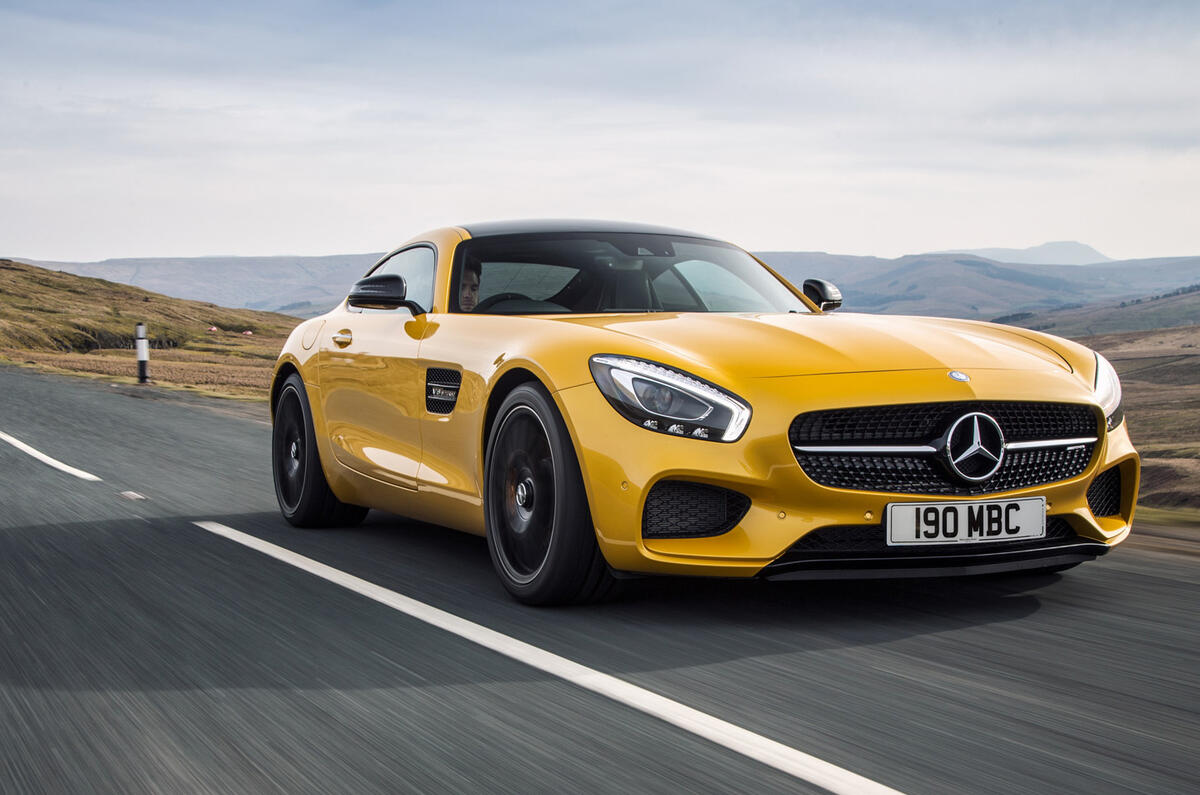


The 2018 Mercedes-AMG GT

The 2018 Mercedes-AMG GT performs brilliantly on any kind of pavement, making it one of our favorite modern sports cars.

Résultat de recherche d'images pour "Mercedes-AMG SLS GT hd"


The 2018 Mercedes-Benz AMG GT is a firebrand for the luxury brand, and a serious contender among the world's sports cars, supercars—even race cars.

This year, Mercedes fleshes out the range even further, which begins with the touring-oriented AMG GT and works its way through GT S, GT C, and track-ready GT R variants. GT and GT C versions are even available as convertibles—just the ticket for high-speed, al fresco ‘bahn burning. We’re big fans of the AMG GT lineup, even if they force considerably daily driver compromises in their quest to deliver the highest level of performance available behind Mercedes’ signature three-pointed star.

All AMG GTs use a 4.0-liter twin-turbo V-8 engine, rated from 469 to 585 horsepower that sends power rearward via a 7-speed dual-clutch transaxle. Even the slowest of the pack sprints to 60 mph in under four seconds, but numbers aren’t the main draw here. The AMG GT delivers the kind of pure driving experience we’ve not seen from a Mercedes-Benz in decades. Even the roughly $112,000 base GT is a raw, but refined corner carver loaded with racing-derived technology.

The AMG GT’s V-8 is mounted behind the front axle, which delivers a 47/53 front/rear weight split. Power makes its way to the transaxle via a massive carbon fiber “torque tube.” Once back there, a true locking differential rapidly sends grunt where it is needed and rear-axle steering on some variants helps these sports cars feel planted on even the most demanding course. Depending on the model, up to five driving modes including a custom-tailored Individual setting let the AMG GT either lope around in town or scream to its maximum potential on a closed course.

What really sets the AMG GT apart, however, is its hydraulic power steering. Rivals have largely adopted electric steering. Even the best systems—we’re looking at the Porsche 911—don’t quite compare to the natural feel delivered through the GT’s thick-rimmed, leather-wrapped tiller.

The AMG GT looks the part, too. Its exceptionally long hood gives way to a curvy, surprisingly upright and short windshield. The roofline tapers into a hatchback with a pair of squinting taillights—perhaps the only view some sports cars will ever see. The droptop is just divine, too, especially when its cloth roof is specified in a muted color rather than the “default” black canvas.


2018 Mercedes-Benz AMG GT
Performance

The 2018 Mercedes-AMG GT might not have the gravitas of the division’s first go-around—the SLS—but this one’s for drivers and drivers alone. We’ve rated this diverse lineup a full 10 out of 10, which is an easy number to reach once you’ve considered its underhood muscle, the tenacity of its handling, the directness of its steering, its compliant ride, and its ability to transform from daily driver to track star at the twist of a control knob. (Read more about how we rate cars.)

At the heart of all versions of the AMG GT lies a 4.0-liter twin-turbo V-8 that sends power rearward via a 7-speed dual-clutch automatic transaxle tied to a pair of delectable paddle shift levers. Placed behind the axle and low into the car’s aluminum space frame, the V-8 ‘s location helps improve the AMG GT’s balance. Base AMG GTs make 469 horsepower, but the 465 pound-feet torque that rolls on just after idle is this engine’s MVP. A guttural snarl through the GT’s sports exhaust further enhances the experience .


Step up to the AMG GT S and power increases to 515 hp and 494 lb-ft, substantial but not exactly earth-shattering figures. Performance is, predictably, a bit more rapid. The bigger change is the inclusion of an adjustable sports suspension to replace the trick Multimatic struts found in the base GT. Comfort mode is softer than the standard GT, while Sport firms things up with little reduction in quality.

The AMG GT C’s 550 hp and 502 lb-ft makes it the master of nearly any road and it adds rear-axle steering that both aids straight-line stability and makes these coupes and convertibles feel even more nimble on a winding country road.

The AMG GT R tops the lineup. Its story goes far beyond the 577 hp and 516 lb-ft of torque rating made possible by upsized turbos. Here, you’ll find the sharpest suspension of the group with universal ball joints that replace control arm bushings in the lower rear wishbones. Even pushed to the limit, they don’t give in. That’s to the detriment of ride quality, but who cares? It means that road feedback through the steering wheel, already an AMG GT asset, is amplified.

A yellow knob sprouting out of the dashboard gives the driver a staggering nine traction control modes to pick from—and that’s not including the five drive modes accessed via a separate knob.

But don’t think that the AMG GT R is the only way to have a pure, honest, driving experience. We hold the AMG GT close to our hearts for its relative simplicity and delightfully analog feel. Then again, the rear-wheel steering that’s on GT Cs is a game-changer, albeit one that comes with a hefty price tag.

Mercedes-AMG CLS 63

Image associée

Mercedes-AMG CLS 63

Although we’re generally remarkably impressed with the inherent efficiency of modern forced-induction motor, why is it that we welcome the 5.5-litre, twin-turbocharged motor in the CLS 63 S with a mild sense of trepidation? 

Mainly because we’ve been so won over by the depth of character and performance of the naturally aspirated 6.2-litre V8 it replaces. However, this engine not only has more grunt than the 6.2-litre V8 but is also 32 percent more efficient.
And in no installation does it make more sense than in the CLS. We already know the four-dour coupé to be excellent luxury transport or for those craving extra practicality a shooting brake, and as a sort of high-end enthusiast’s limo it can justify having 576bhp better than most other Mercedes. 

But there’s no point to having such extravagant outputs – or an equally extravagent price – if it’s not sensationally entertaining, as well as civilised executive transport. And that’s not an easily achieved compromise.

In 2014, the Mercedes-Benz CLS was given a facelift, which largely was condensed to a new front grille, bumper and headlights, while the inside was given a light sprucing up. The CLS 63 S gained a wet clutch version of its seven-speed automatic as AMG seeked faster shifting to help unlock its performance potential.

Mercedes Benz G63 AMG

Résultat de recherche d'images pour "mercedes benz g63 amg hd"


Mercedes Benz G63 AMG

The Mercedes-AMG G 63 replaces the old supercharged G 55 as the most powerful, quickest and most expensive version of the venerable G-Class 4x4 available in the UK.


Joining the six-cylinder diesel G 350 Bluetec in a revamped G-Class range that boasts higher levels of luxury than ever inside, the G 63 is powered by AMG’s latest twin-turbocharged 5.5-litre V8, whose 563bhp and 561lb ft of torque are sufficient to propel this 2.5-tonne brick from 0-62mph in a startling 5.4sec. Although these are startling figures, it is a great shame that the UK misses out on the 4.0-litre V8 and 6.0-litre V12 iterations of the AMG G-Class found elsewhere in the world, something which Mercedes-AMG don't seem keen to rectify for the 2018 edition.

The V8 is mated to an equally modern AMG Speedshift seven-speed automatic transmission with a stop-start function and a choice of three modes.

This powertrain means that while the G 63 is the quickest G-Class in its history, it is also more economical than its thirsty predecessor and emits less CO2 – although figures of 20.5mpg combined and 322g/km hardly qualify the G 63 as being eco-friendly.

While it’s instantly recognisable as the ruggedly rectilinear Geländewagen that has been around for more than three decades, the G 63 can be distinguished from lesser models by a unique radiator grille and front bumper, flared wheel arches, stainless steel running boards, a macho side-exit sports exhaust system and big alloys. It is also the subject of other mental AMG projects, most notably the Mercedes-AMG G 63 6x6.

Inside, the G 63 now features a more modern dashboard with a new instrument cluster and centre console, as well as a more generous standard equipment level than its predecessor. But despite the unashamed luxuriousness of its cabin, the G 63 remains a potential go-anywhere vehicle, featuring three differential locks and a low-range transfer box for serious off-roading.

As for equipment levels there are three choices - the standard G 63 trim, Colour Edition and Edition 463. The normal G 63 comes with all the bravado AMG like to instill on its creations, notably the 20in alloys, chrome quad side exhausts, red brake calipers and stainless steel side sills, while inside gains climate control, a leather upholstery, a Harman & Kardon sound system and Mercede's Comand infotainment system. The Colour Editions merely give buyers the choice of five rather garish colour combinations - Tomato Red, Alien Green, Galactic Beam, Solar Beam and Sunset Beam.

The range-topping Edition 463 model gains numerous additional luxuries including, 21in alloy wheels, stainless steel under engine guard, headlight protectors, rear TV screens and tuner, two-tone leather seats, a heated windscreen and driving aids - blind spot assistance and adaptive cruise control. All of which adds more luxury and rugged toughness to the exterior.

Despite the way it looks on the outside, the G 63 is anything but a utilitarian vehicle on the inside. High-quality leather covers most surfaces, including the cliff face of a dashboard, and it’s even ruched in the door panels. All of the technology you'd expect to find in any other Mercedes-AMG products is present and correct in the G 63 too, including a Comand Online multimedia system with a seven-inch colour screen perched in the middle of the dash.

Most of the switchgear is familiar Mercedes fare, too – the exceptions being the trio of diff lock buttons high up on the centre console and a low-range selector button lower down. The lofty driving position is quite upright, but it’s very comfortable and roomy up front (although rear legroom isn't exactly generous); you're a lot less likely to crack your elbow against the door than in a Land Rover Defender.

That comfort continues when the car is rolling. Despite its old-school rigid axles, the G 63’s ride is compliant and reasonably well controlled and refinement is commendable for this type of vehicle.

There’s a fair bit of body roll in corners and the quaint old recirculating ball steering is low-geared enough to keep the driver quite busy at times, but in general the G 63 is better mannered than you might expect, albeit no Porsche Cayenne or Bentley Bentayga. And unlike the gargantuan seven-seat GLS, the G-Class isn’t so wide that feels out of place on an average British road.

One source of noise that is always welcome, of course, is that big twin-turbo V8 and the bellow that emerges from the naughty side-exit exhausts whenever you stir the throttle.

Once you’ve overcome a moment of initial inertia, the G 63 accelerates with the same inexorable force as a Bentley. Put it this way: its swollen performance is more than adequate for a vehicle like this, and easily accessed. You can even change gears manually via paddle shifters if you want.

Objectively, you’d have to say that paying £133,000 or more for a vehicle like this is completely bonkers; any number of other, more modern luxury SUVs will do a better job for less money, namely the Range Rover Sport SVR, Audi SQ7 or Porsche Cayenne Turbo. But subjectively, the appeal of its thumping V8 performance and its ‘old on the outside, new on the inside’ design is as clear as that of a contemporary apartment in a converted warehouse.


The G 63 may be an esoteric choice that probably has even less right to still exist than the G 55 before it, but it is charming, distinctive and likeable all the same.

Wednesday, April 4, 2018

Jeep Grand Cherokee SRT8


TESTED Jeep Grand Cherokee SRT8.

WHAT IS IT? High-performance sport utility.

HOW MUCH? $40,725 base for 2008; $45,690 for ’07 model as tested with $1,645 navigation system and backup camera; $2,095 SRT Option Group 1 (Sirius Satellite Radio, remote engine starter, power-adjustable pedals, rear parking assist, rain-sensitive wipers; heated front seats); $800 sunroof and $225 Red Rock Crystal Pearl paint.

WHAT’S UNDER THE HOOD? 6.1-liter Hemi V-8 (420 horsepower, 420 pound-feet) with five-speed automatic transmission.

IS IT THIRSTY? With an E.P.A. rating of 11 m.p.g. city and 14 highway, the SRT8 has a serious drinking problem. (Overall mileage as tested: 9.9 m.p.g.)

YOU may have heard about Chrysler’s new lifetime warranty. Buy a Chrysler, Dodge or Jeep and the powertrain warranty remains in effect for as long as you keep the vehicle. I’m already looking forward to stories in 2038 about geezers tooling around in 2008 Jeeps that are road-going ships of Theseus, on their fourth engine and fifth transmission yet still under warranty.

If I had an infant, I’d be sorely tempted to buy a Wrangler, put it in the baby’s name, then feel incredibly smug 16 years hence when the family’s high-school beater is still under warranty. Maybe I’d buy a homely Compass, too, just to keep as a threat.

Continue reading the main story
But read the fine print of the End Times Warranty and you’ll see that not all Jeeps are eligible; the Grand Cherokee SRT8 makes do with a three-year or 36,000-mile warranty.

At first I thought that strange — the SRT8 is a Jeep with absolutely no off-road pretensions, and therefore no chance of getting a tree stump through the transfer case. But once I got behind the wheel I realized that each shiny SRT8 you see on the street has probably been subjected to mechanical savagery to make, by comparison, the most dented and mud-spattered Wrangler Rubicon seem as benignly chauffeured as the Popemobile.

What’s the line about absolute power corrupting absolutely? Well, if you are the slightest power-hungry the SRT8 corrupts your driving style because you’re constantly tempted to put the spurs to the animal under the hood, a 420-horsepower Hemi V-8 that emits a thunderous bellow from twin four-inch exhaust tips.

While every other recipient of this motor has rear drive and is thus traction-challenged off the line, the Jeep has all-wheel drive. Floor the throttle and the rear tires scratch the pavement for a moment before power is ushered to the front and 4,819 pounds of S.U.V. leap forward like a goosed hippopotamus. Jeep says the SRT8 will zip from a stop to 60 miles an hour in less than 5 seconds — even in the rain.

Members of Chrysler’s Street and Racing Technology group didn’t go home once they’d bolted their signature motor under the Grand Cherokee’s hood. For instance, I can confidently declare, without so much as a Google search, that this is the first Jeep to employ Italian brakes — four-piston aluminum calipers from the house of Brembo, squeezing front rotors that are larger than the entire wheels of a Chevy Aveo LS. (Even the rear discs, at 13.8 inches, dwarf a Corvette’s front rotors.)

The SRT8’s wheels are 20 inches of forged aluminum wrapped with Z-rated Goodyear Eagle RS-A tires, 255-width up front and chunky 285s on the rear. Lest we forget this is a truck, those rear wheels are bolted to a heavy-duty Dana 44 solid axle, an item so cherished by off-road aficionados that you can buy sterling silver earrings cast in the likeness of its differential cover. Just the thing for the little lady who appreciates a sturdy ring and pinion.

The SRT8 puts up big numbers, but it’s like a hockey goon — all brute strength and no finesse. Those heavy brakes, wheels and rear axle thud crudely over bumps. Directional changes are effected with all the lithesome agility of a sinking tugboat. But when you point it straight and bury the throttle, you experience Porsche Cayenne Turbo performance for about half the money.

Did I say all was forgiven? The fuel consumption qualifies as unforgivable. I averaged 9.9 m.p.g., mostly in urban driving. Now I may have driven as though I had a trunk full of moonshine and federal agents on my tail, but the Grand Cherokee SRT8 brings to mind the old chestnut: if you left it running at the pump, would it ever fill up?

But I doubt that many people are racking up big mileage commuting in Grand Cherokee SRT8s. This is a special vehicle, an occasional toy in the vein of a Porsche or Corvette. I had valets complement it and park it next to their booth. The SRT8 strikes me as the kind of oddball limited-edition performance machine that will inspire a cult of people who will cherish its strange talents for years, long after its thirsty V-8 is out of style — and out of warranty.